
In the post-pandemic workplace, organizations are under pressure to adopt new technologies to stay competitive. With the rapid advancement of Large Language Models (LLMs), many companies are exploring LLM-based knowledge tools through proof-of-concept (PoC) projects across departments. This shift marks a fundamental evolution in how knowledge is managed.
Traditional knowledge management (KM) has often been mistaken for simple information handling. True KM, however, involves creating new knowledge through problem-solving, interacting with the environment, and fostering a culture of continuous learning. It relies on leveraging skills, experiences, routines, norms, and technologies to reuse and grow organizational know-how.
LLMs as Virtual Experts
LLMs are transforming the KM landscape. Acting as virtual experts, they can process vast amounts of enterprise data to support decision-making and streamline operations. By improving efficiency, LLMs help employees save time when searching for relevant information.
The Rise of Employee-Supporting Private LLMs
The growing importance of employee-supporting private LLMs marks a significant shift in how organizations leverage language models. While LLM applications typically fall into three categories, customer-facing tools, employee-supporting tools, and internal search and analysis, the employee-supporting use case is gaining particular relevance.
This is especially true in domains such as customer advisory, compliance, risk management, and legal support, where sensitive data is frequently handled and the impact on customers is often indirect. Given the heightened concerns around data privacy and security in these areas, many organizations are opting for private LLM deployments. On-premises solutions are especially attractive because they offer greater control.
A Dedicated Maturity Model Towards Addressing LLM Challenges
Before launching complex AI initiatives, organizations must assess their readiness. Generic maturity models focused on AI, KM, or manufacturing do not capture the specific requirements of LLM-based KM in sensitive environments.
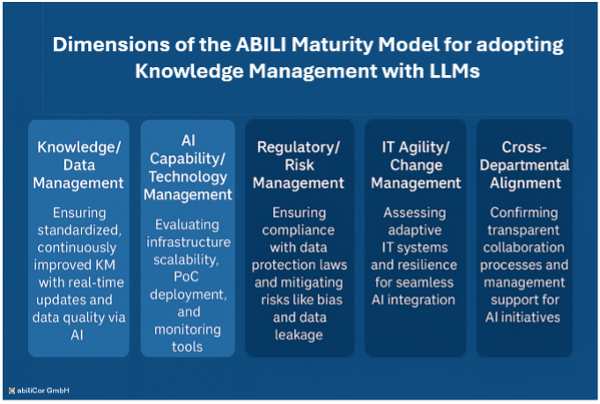
The maturity model on the ABILI Platform is tailored to evaluate readiness for implementing LLM-powered KM tools. It combines KM best practices, based on the Building Blocks of Knowledge Management, with modern AI readiness frameworks.
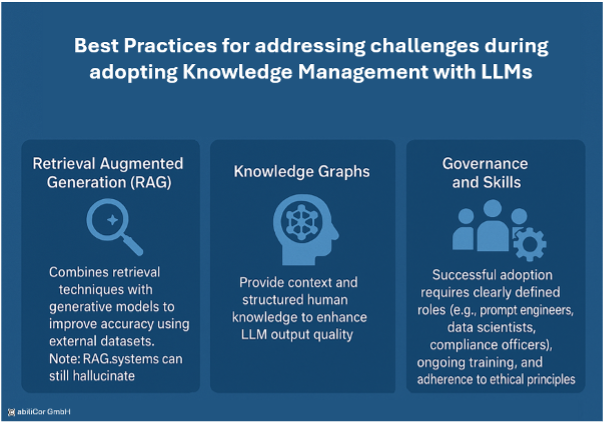
Not Only Assessing but Also Addressing LLM Challenges with Best Practices
Despite their power, LLMs face challenges such as hallucinations (generating false or misleading information), reliance on outdated data, and opaque reasoning mechanisms. Our maturity model incorporates best practices to mitigate these risks.
Conclusion
LLMs offer transformative potential for efficiency and innovation in enterprise knowledge management. But success depends on how well organizations prepare. A dedicated maturity model helps identify strengths and gaps, enabling responsible and effective AI adoption.