
The consulting industry is undergoing a significant transformation. As digital technologies reshape how knowledge is accessed, shared, and applied, the traditional face-to-face consulting model is being challenged by new approaches, for example, algorithmic tools that automate data analysis and generate recommendations, and self-service portals where clients can independently conduct assessments and access insight.
From Human Teams to Human-Machine Collaboration
What was once a fully bespoke, interview-heavy craft is becoming a hybrid discipline where machines gather, structure, and visualize evidence while humans frame problems, arbitrate trade-offs, and make accountable decisions. This change is already observable in practice: large firms are retraining their workforces to deliver engagements with AI assistance embedded in the workflow. At the same time, self-service analytics are expanding rapidly as organizations seek to empower frontline staff with diagnostic tools and bring data-driven decision-making closer to daily operations.
Large Language Models (LLMs) such as GPT-4, Copilot, Perplexity are accelerating this transformation. Their ability to understand natural language, generate structured outputs, and synthesize vast amounts of information in real time makes them ideal partners in consulting workflows. LLMs can support consultants by:
- Drafting client-ready documents from structured inputs
- Summarizing stakeholder interviews or survey results
- Generating hypotheses or strategic options based on market data
Levels of Interaction: Who Holds the Control?
But what does this mean for the way consultants work, and how they collaborate with machines? At the core of effective collaboration is a simple idea: use machines to expand the evidence base and accelerate first-pass analysis; use humans to supply context, judgment, and governance.
A foundational framework for understanding collaboration is the 3C model, which defines collaboration as the interplay between communication, coordination, and cooperation. While originally developed to describe human teamwork, this model has since been extended to human–machine interaction, where machines become active participants in collaborative processes.
To better understand the depth of such collaboration, we have applied and adapted Sheridan's taxonomy, which categorizes levels of control in human–machine systems. While interaction is possible at all levels, meaningful collaboration, where both human and machine contribute, is most evident between levels 3 and 6. At these levels, the machine supports the human by providing options, making recommendations, or carrying out actions under human supervision, but does not make final decisions independently. This enables a balanced distribution of responsibility.
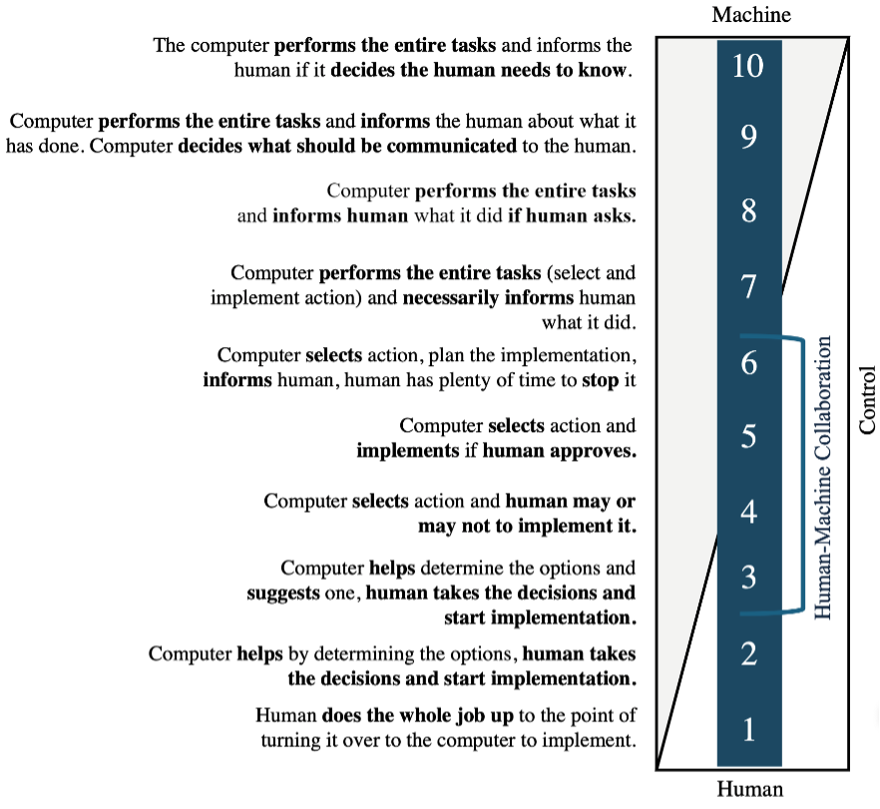
Level of control in Human-Machine Interaction (adapted from Sheridan, 1988)
How the ABILI Platform Connects Humans and Machines in Consulting
The ABILI Platform illustrates how modern platforms can structure and support the way humans and machines work together to conduct digital transformation consulting. Instead of viewing machines purely as tools, they are increasingly becoming active partners in the consulting process. With the help of language models, the portal can analyze data, suggest decision options, and support various processes. The machine does not replace the consultant but complements human expertise, reduces manual tasks, and enables faster iterations.
Through the integration of self-service assessments and maturity models, organizations can independently assess their digital maturity. This allows them to identify strengths and weaknesses and derive targeted areas for action. The platform supports collaboration within teams and makes it easier to include different perspectives in decision-making. These functions offer:
- Easy access to structured analyses
- Clear insights into the current state of digital transformation
- Personalized recommendations for next steps
The focus is on augmenting human capabilities with machine support, rather than pursuing full automation, always within the boundaries defined by human judgment and ethical standards. Overall, this shift from automation to collaborative work with AI opens up new possibilities for integrating collective intelligence into strategic decisions and making transformation processes more efficient.
The Future of Consulting: Hybrid, Scalable, and Human-Centered Collaboration
Digital platforms offer enormous potential for scalability and efficiency. Routine, information-based tasks can be automated, freeing consultants to focus on strategic and creative work. This shift allows consulting firms to scale their impact beyond the limits of human resources.
The digitalization of consulting is not about replacing humans, it's about redefining collaboration. Platforms like ABILI aim to reach level 6 of human–machine interaction, where machines provide recommendations and support decision-making, but humans retain ultimate control and responsibility. This balanced approach respects the expertise of consultants while leveraging the power of intelligent systems.
As the industry evolves, success will depend on our ability to embrace change, design ethical systems, and build trust between humans and machines. The future of consulting is likely to be hybrid, human-centered, and digitally empowered, a transition that is already in progress.