
On September 29, 2025, the swiss{ai}weeks hosted a webinar focusing on how private Large Language Models (LLMs) are reshaping knowledge management within organizations. Participants had the opportunity to assess the LLM Adoption Maturity in their own companies by taking part in a short self-assessment. This was conducted via the ABILI Platform, which supports organizations in evaluating and guiding their journey toward effective LLM integration.
Knowledge management is more than storing documents. It's about transforming experience into actionable insights, sharing those insights across teams, and using them to drive innovation. A robust Knowledge Management System (KMS) empowers employees to access relevant information quickly, avoid duplication, and build on existing knowledge.
The Role of Private LLMs
Artificial intelligence is reshaping the way organizations access and manage knowledge. Among the most powerful tools emerging today are LLMs. But while public models have opened the door to exciting possibilities, they also raise concerns around sensitive data, regulatory compliance, and relevance to specific business needs. This is where private LLMs come into play.
What Makes a Private LLM Different?
Private LLMs are AI-powered language models that are tailored to an organization's internal data. Unlike public models that run on external servers and rely on general internet knowledge, private LLMs operate securely within company boundaries.
This approach brings three major advantages:
- Data Privacy – Information never leaves the organization. Sensitive business or customer data remains protected and fully under company control.
- Context and Relevance – Trained or fine-tuned on internal documents, processes, and terminology, the model understands the language and workflows unique to the organization.
- Practical Support – Employees can rely on the model to generate content, summarize reports, answer questions, and provide intelligent, context-aware responses that fit their specific environment.
Challenges in Private LLM Adoption
Despite their potential, private LLMs are not plug-and-play solutions. Many organizations face hurdles such as unclear usage policies, incomplete training data, lack of human oversight, and insufficient attention to social knowledge transfer. Technology alone isn't enough, human interaction and tacit knowledge sharing remain essential.
To spark discussion, we asked the webinar participants: "Which challenges have you faced when working with private LLMs?". The responses, visualized in a dynamic word cloud, revealed a clear pattern and the need for strategic guidance, governance frameworks, and cross-functional collaboration in navigating the LLM adoption journey:
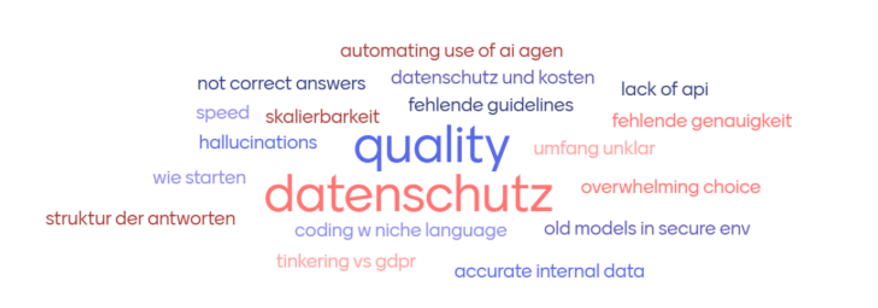
Key Challenges in Working with Private LLMs
Insights from Participant Responses at the swiss{ai}weeks webinar on September 29, 2025
- Data protection emerged as the most prominent concern, highlighting the tension between innovation and compliance.
- Lack of accuracy and quality issues were frequently mentioned, pointing to the need for robust evaluation and fine-tuning strategies.
- Participants also noted the overwhelming choice of models and tools, which complicates decision-making and integration.
- Technical barriers such as missing APIs, hallucinations, and speed limitations were also cited.
- Interestingly, the challenge of automating the use of AI agents suggests a growing interest in operationalizing LLMs beyond experimentation aiming to integrate LLMs into core business processes, moving from proof-of-concept stages to scalable, production-ready applications.
The Use Cases of Using LLMs in an Organisation
Large Language Models (LLMs) can be strategically deployed across three core areas within an organization to support key business goals: growth, efficiency, and protection. In customer-facing contexts, LLMs enhance client interactions by delivering faster, more personalized service while ensuring that sensitive customer data remains secure, driving both business expansion and trust. In employee-facing applications, LLMs streamline internal operations by simplifying access to information and automating routine tasks, improving efficiency with relatively low risk. In employee-augmenting scenarios, LLMs empower staff in knowledge-intensive work, supporting data analysis, decision-making, and compliance, unlocking innovation while requiring careful oversight to protect sensitive information. Together, these use cases demonstrate how LLMs can be integrated across different organizational layers to unlock transformative value.
Measuring LLM Adoption Maturity with the ABILI Platform
A key element of the webinar was the opportunity for participants to assess their organization's readiness for LLM adoption using the Assessment Agent of the ABILI Platform. Developed by abiliCor, the portal is a toolset designed and built using agentic AI technologies to guide organizations through a structured transformation journey.
It begins with Onboarding, where strategic goals and transformation ambitions are clarified to establish a vision-driven foundation. In the Assess phase, organizations evaluate their current state using targeted maturity models, such as the LLM Adoption Model, which spans five dimensions, 24 categories, and 186 best practices. Based on these insights, the Architect phase enables the design of a tailored roadmap that aligns value-generating initiatives with strategic priorities. The Act & Coach phase focuses on empowering employees to implement these initiatives through enablement, coaching, and continuous support. Finally, in the Advance phase, organizations track progress, measure impact, and initiate the next cycle of improvement, ensuring that transformation is not a one-time effort but a continuous evolution.
The AI agents of the ABILI Portal guide organizations through a structured transformation process. These agents are implemented as RAG-based chatbots (Retrieval-Augmented Generation) and leverage internal knowledge to ensure accuracy and trustworthiness in their responses. The ABILI Platform serves not only as a diagnostic tool, but also as a strategic compass and intelligent assistant for digital transformation, including the adoption of private LLMs.
The Results of the Measurement of the Webinar Participants' Maturity
During the webinar the participants completed a brief self-assessment based on selected categories of the ABILI LLM Adoption Maturity Model such as Knowledge Identification, Distribution, Use, Preservation, Measurement, and AI Compliance, among others. The responses reflected how satisfied participants were with the implementation of these practices in their own organizations. Many of the challenges identified, such as data protection, lack of accuracy, and missing APIs, map directly to categories in the maturity model, including AI Compliance, Knowledge Quality, and Technical Enablement.
The collected data was then analyzed and visualized in a spider chart, offering a clear and comparative view of maturity levels across different dimensions. This approach enabled participants to identify strengths and gaps in their LLM adoption journey and served as a valuable input for strategic reflection and planning.
The following chart visualizes a selection of participant responses that are representative of the overall results. Each axis ranges from 0 to 6 and reflects satisfaction with the implementation of best practices across key maturity model categories. The chart includes individual ratings from ten anonymous participants, alongside an aggregated average labeled "All Participants":
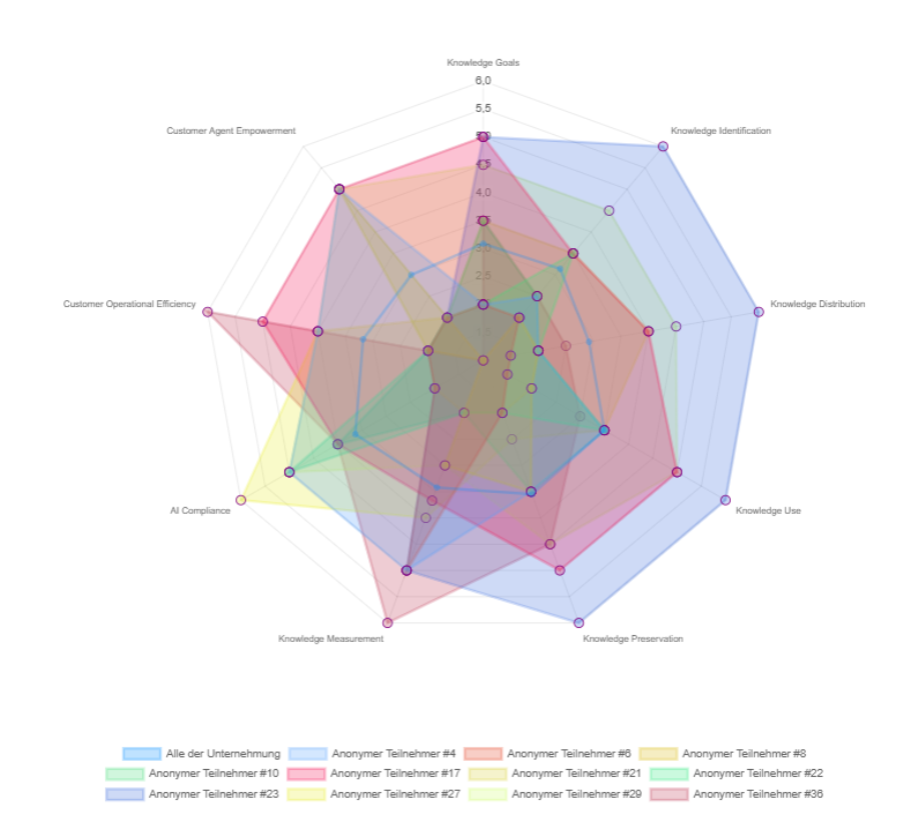
Comparative View of Maturity Levels Across Selected Categories
Visualization of participant responses showing satisfaction with best practice implementation
Individual ratings from ten participants plus aggregated average ("All Participants")
The key observations are:
- Strongest Areas: Most participants reported higher satisfaction in Knowledge Goals and AI Compliance, suggesting that strategic intent and regulatory alignment are relatively well established.
- Weaker Areas: Knowledge Measurement and Customer Agent Empowerment consistently received lower scores, indicating challenges in tracking impact and enabling end-users effectively.
- Variation Across Participants: The chart shows significant variability between organizations. Some participants rated themselves highly across most categories, while others showed uneven maturity, highlighting the diverse stages of LLM adoption.
- Overall Profile: The average polygon ("All Participants") forms a balanced but modest shape, suggesting that while foundational elements are in place, there is room for improvement in operationalization and user-centric implementation.
The self-assessment results revealed a clear contrast: On the one hand, participants expressed high confidence in strategic knowledge goals and AI compliance, showing that many organizations have already laid a solid foundation for responsible LLM adoption. On the other hand, lower scores in knowledge measurement and customer agent empowerment pointed to a common challenge, while the strategy is often in place, translating it into measurable impact and empowering users remains a hurdle. This gap highlights the need to move from vision to execution, ensuring that LLMs not only align with business goals but also deliver tangible value in daily operations.
Recommendations for the Next Step
- Start with a Pilot Project: Begin in a well-defined domain such as internal FAQs, document summarization, or knowledge retrieval. This allows for controlled experimentation, measurable outcomes, and early wins that build momentum. When planning your pilot project, it's helpful to align it with one of the three core LLM use case categories mentioned above:
- Customer-Facing Use Cases: Deploy LLMs to enhance client interactions, e.g., by automating responses to inquiries, summarizing contracts, or generating personalized content. These applications support growth and data protection simultaneously.
- Employee-Augmenting Use Cases: Use LLMs to empower staff with intelligent access to new knowledge. Examples include customer or stakeholder data, client journey identification, understanding customer, applying policy or legal terms for single clients. These use cases drive efficiency and innovation to apply new knowledge or generate new knowledge through intelligent solutions.
- Employee-Facing Use Cases: Optimize internal operations by integrating LLMs into workflows, e.g., for formalized knowledge retrieval, meeting preparation, or internal FAQs. These applications strengthen operational efficiency and knowledge preservation.
- Ensure Cross-Functional Involvement: Successful LLM integration requires collaboration across departments. Engage stakeholders from IT, legal, and business units to align technical feasibility with compliance and operational needs. This fosters shared ownership and smoother implementation.
- Foster Leadership Commitment and Cultural Readiness: LLMs are not just technical tools, they represent a shift in how knowledge is accessed and used. Leadership must actively support this transformation, and the organizational culture should be open to AI-assisted decision-making, experimentation, and continuous learning.
Conclusion: A Strategic Path Forward
"LLMs are not just tools, they are catalysts for humans to rethink how they manage and share knowledge in organizations."
The webinar highlighted both the promise and complexity of LLM adoption. As organizations move forward, tools like the ABILI Platform will be essential in navigating this evolving landscape. We invite you to explore your own maturity level and join the conversation on shaping the future of AI-powered knowledge management.
Book a demo on the abiliCor website and take the first step toward your AI-powered future.